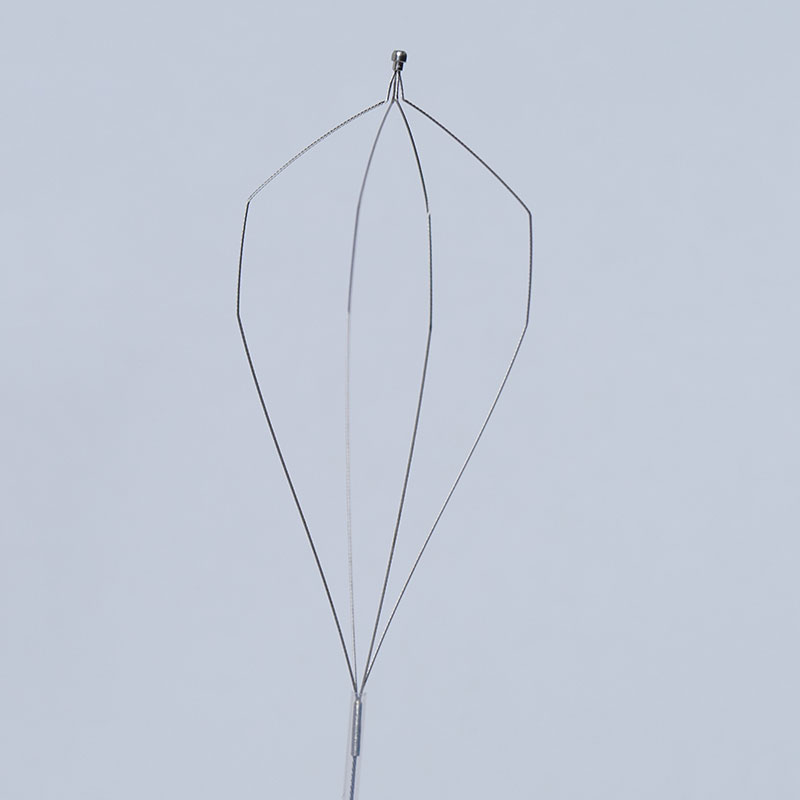
These are single-use, minimally invasive endoscopic consumables commonly used in conjunction with veterinary endoscopes; they are also known as basket-type foreign body forceps or stone retrieval baskets.
Stone-retrieval Basket (Basket-Type Foreign Body Forceps) These are single-use, minimally invasive endoscopic consumables commonly used in conjunction with veterinary endoscopes; they are also known as basket-type foreign body forceps.
Head: A cage-like basket woven from nickel-titanium shape-memory alloy wire that can be expanded and contracted.
Sheath: A smooth PTFE outer sheath into which the basket can be retracted.
Handle: Typically a three-ring handle, allowing for one-handed control of basket expansion and contraction.
The basket extends from the sheath and automatically opens; after enclosing the target, the sheath is retracted, causing the basket to close and securely encase the object. It grips the object through enveloping friction rather than by biting or clamping.
Suitable for smooth, round, and fragile objects: stones, coins, buttons, marbles, gastric stones, food boluses, capsules, etc. These objects are less likely to be crushed or slip out, resulting in minimal damage to the mucosa.
Pet digestive endoscopy, removal of airway foreign bodies during respiratory endoscopy, etc.
Not suitable for: fish bones, needles, fragmented metal, and other sharp foreign bodies, as sharp objects can easily puncture the mesh basket or scratch the tube wall; rat-tooth forceps are generally used for such cases.
Stone-retrieval Basket: Enveloping grasp; suitable for smooth, spherical objects; not suitable for sharp objects.
Alligator-jaw/rodent-tooth forceps: Bite-and-grip action; suitable for flat, rod-shaped, or sharp foreign bodies.