"Dr. Li, my cat ate a needle and thread last night. The X-ray shows the needle in its stomach, but I can't see where the thread is at all. What should I do?"
An anxious cat owner paced back and forth in the veterinary hospital. On the X-ray, the shadow of a needle tip was clearly visible, but the suture connecting it seemed to have vanished, impossible to find. If surgery was performed rashly, there was a high possibility that the foreign object would be found after cutting open the abdomen, resulting in unnecessary surgery; if surgery was not performed, the risk of the needle wandering inside the body remained ever-present.
This is not a made-up story.

This is a thorny problem that many pet hospitals face every day.
Just as the cat owner was becoming anxious, Dr. Li brought in a small piece of equipment—a long, thin tube and a display screen with a joystick for quick operation. On the screen, the direction of the thread, the position of the needle, and the extent of mucosal damage were all clearly visible. Finally, the forceps under the endoscope precisely gripped the needle and thread, smoothly removing it through the esophagus. The entire procedure involved no incisions, and the cat was able to eat canned food that afternoon.
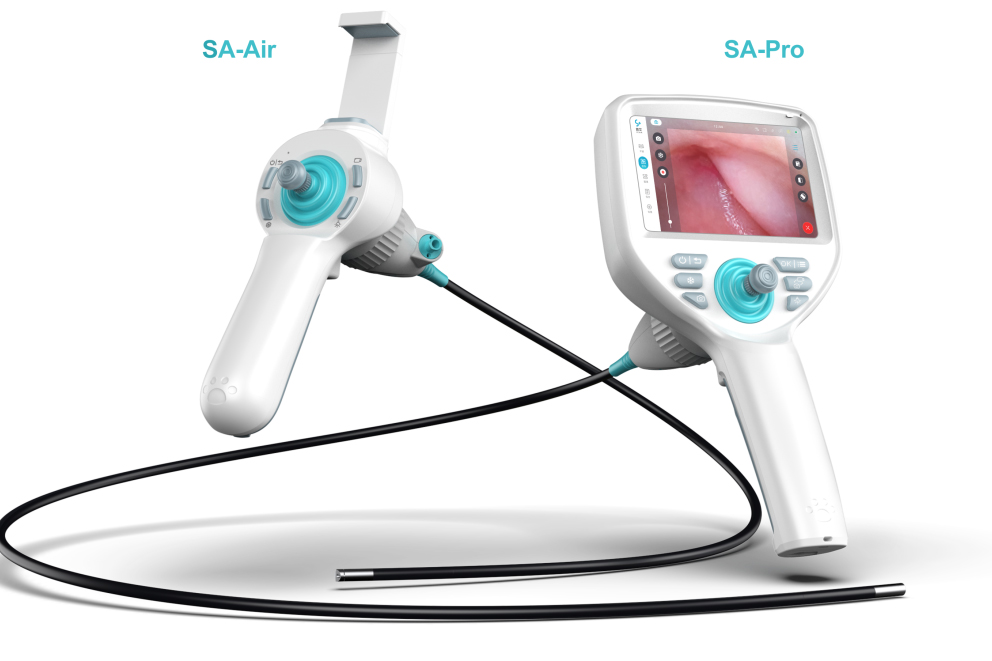
This device is the SOAIM SA series pet endoscope .
But did you know that some incredibly cheap "pet endoscopes" on the market are actually just industrial endoscopes with different sizes? Can the standards used in car engines really be applied to living, breathing furry friends?
Today, let's talk about the differences in standards between performing a gastroscopy on a kitten and performing a gastroscopy on a human.
"Medical grade" is not a marketing tactic, but a genuine requirement.
Many people think that an endoscope is just a tube with a camera, and if it can be used on humans, it can be used on cats and dogs too, right? This idea is completely wrong.
Performing an endoscopy involves the patient being sedated or anesthetized, lying on the examination table, and following the doctor's instructions. Human anatomy is relatively standardized, doctors undergo systematic training, and the procedures are predictable. The examination can proceed slowly, and vital signs are monitored throughout by an anesthesiologist.
Performing endoscopy on pets requires general anesthesia, and the metabolism of anesthetic drugs varies greatly among different breeds and weights of dogs and cats, so there is no "standard formula." Anatomical variations are significant—cats have narrow, thin-walled esophagi, small dogs have small stomach volumes, and their bronchial bifurcation angles differ from humans. More importantly, pets are uncooperative, the examination window is limited, and the longer the anesthesia time, the higher the risk.
"When performing a gastroscopy on a human, you can make a thorough diagnosis; when performing a gastroscopy on a cat, you need to be quick because the anesthesia time is short, and it's best to finish within 15-20 minutes," a senior veterinary endoscopist summarized.
A truly "medical-grade" endoscope suitable for pets must be specifically designed to address these differences, rather than simply copying the dimensions of human medical equipment. It must meet stringent standards in at least the following three dimensions.
[Imaging] Exquisite detail, with zero tolerance for error.
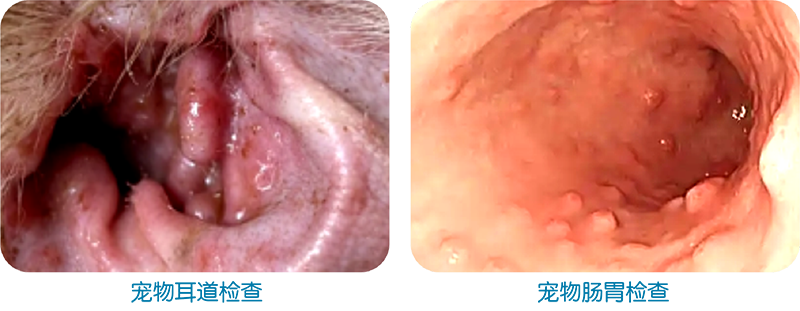
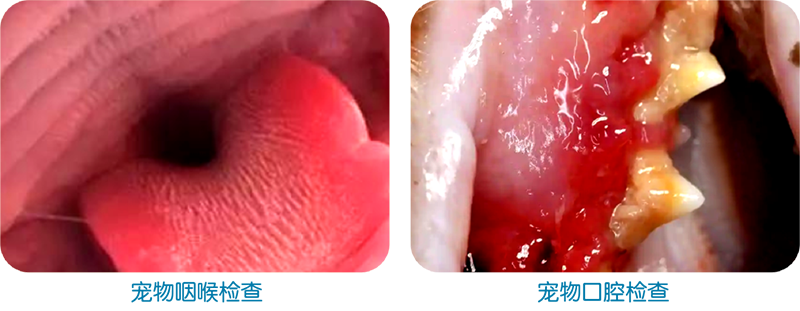
When performing a gastroscopy, doctors want clear, accurate images to precisely determine changes in mucosal color and subtle lesions. The human digestive tract has a relatively large lumen, allowing the endoscope ample space to move in and out.
Performing gastroscopy on cats demands even higher standards. Cats have thinner stomach walls, more complex mucosal folds, and a shorter examination window, requiring extremely high imaging efficiency and detail. Substandard image quality can easily miss early lesions.
FirstAi Technology's SA series pet endoscopes have made significant strides in imaging:
It adopts a 500,000/1,000,000 pixel module, which can be flexibly selected according to different inspection needs. The probe is equipped with a 120°-140° wide field of view design, providing a wide observation range and effectively reducing blind spots.
With a depth of field of 3-50mm, it can maintain clear imaging at both close and long distances, making it easy to observe tiny lesions close to the mucosa or view the entire cavity from a distance.
Front-mounted LED lighting with adjustable brightness levels from 0 to 3 ensures optimal observation results in various body cavities, avoiding overexposure or underexposure.
With its 8x local magnification function and one-click operation for taking photos, recording videos, and freezing images, doctors can easily capture and record key lesions. In SOAIM's clinical trials, this imaging system helped doctors accurately identify early gastric ulcers, esophageal strictures, and multiple mucosal congestion lesions, effectively avoiding misdiagnosis and missed diagnosis.
[Safety] Humanistic "Gentleness" Below Body Temperature
When performing an endoscopy on a human, the human mucous membrane has a certain tolerance to temperature, and medical equipment has strict temperature rise standards (the maximum temperature of the insertion part surface should not exceed 41°C).
Performing endoscopy on pets—dogs and cats have more sensitive mucous membranes than humans, and prolonged contact with the heated probe can easily cause thermal damage. Many so-called "pet endoscopes" directly use industrial or human medical lighting and heat dissipation solutions without being optimized for small animals.
Overheating is the most insidious "hidden killer" of pet endoscopy.
Human medical standards stipulate that the maximum temperature of the insertion site surface must not exceed 41°C (normal human body temperature is about 37°C, and the temperature rise should not exceed 4°C). This standard also applies to pets, and is even more stringent.
The SOAIM SA series features front-mounted LED lighting, coupled with optimized circuitry and heat dissipation design, strictly controlling the surface temperature of the insertion part below 41℃, meeting medical-grade safety requirements. Simultaneously, the probe boasts an IP67 protection rating, supports immersion cleaning and disinfection, and is reusable—ensuring clinical hygiene and safety while reducing equipment costs per procedure, truly achieving "one-time investment, long-term use."
[Materials and Design] From "Living Body Adaptation" to "Integrated Diagnosis and Treatment"
For human endoscopy—equipment can be repeatedly sterilized and reused, and materials must meet biocompatibility standards. The operating channel design is mature, with each channel—air injection, water injection, suction, and instrumentation—performing its specific function.
Performing endoscopy on pets requires addressing the contradiction between "small space and multiple functions" while ensuring biocompatibility. The probe needs to be thin, but it cannot lack functionality.
FirstAi's SA series of endoscopes provides targeted solutions—
Firstly, it offers flexible customization and multi-purpose functionality: supporting both Φ4mm and Φ6mm probe sizes, it features a Type-C interface with a release button, enabling rapid tubing replacement within 3 seconds. A single unit can be adapted to different animal sizes and examination sites (such as the respiratory and digestive tracts), significantly reducing equipment procurement and maintenance costs. Specific parameters (tubular diameter, pixels, field of view, depth of field, working length, bending angle, etc.) can be customized upon request.
Secondly, the multi-functional operating channel integrates air injection, water injection, suction, and instrument channels via a Y-type valve.
Connecting a manual airbag allows for cavity expansion, improving the field of vision;
The syringe can be connected to flush the lens with water or aspirate fluid to maintain clear vision during surgery.
It supports the insertion of disposable consumables such as biopsy forceps and cell brushes to complete tissue sampling.
This design truly achieves "integrated diagnosis and treatment"—detecting lesions, taking samples or treating them on the spot, without the need to change equipment, significantly shortening anesthesia time, and reducing surgical risks.
Thirdly, medical-grade materials: SA series tubing uses polyurethane (PU) tubing, which is flexible, resistant to bending and wear, and has a smooth outer wall. When in contact with mucous membrane tissue, it has low friction and is less likely to cause secondary damage.
"We initially bought a 'miniature human endoscope' costing a few hundred yuan, but after less than two months, the surface of the insertion tube started to peel and feel rough. After several sterilizations, the images became unreadable. We switched to the SOAIM SA series, and the polyurethane tubing felt noticeably different. It's still like new after more than half a year of use," a purchasing manager from a pet hospital shared.
Thirteen years of accumulation, created specifically for pets.
First AI Technology's Technological Confidence
You might ask: With so many standards, how does First AI Technology manage to meet them?
The answer lies in its "technological foundation".
Sooai Technology is backed by its parent company—a national high-tech enterprise with over 120 patents and products covering more than 120 countries and regions. More importantly, it boasts a strong supply chain advantage. Sooai Technology possesses a complete R&D, production, and supply chain system, with everything from optical design and mold making to complete machine assembly and performance testing being independently controllable.
This means that when pet hospitals need to customize special specifications (such as insertion tubes of different diameters and working lengths), SOAIM can respond quickly, while brands that rely on OEM manufacturing can only "sell whatever they have".
The SOAIM SA series pet endoscope is not a "miniature version of a human endoscope," but a professional device designed and validated systematically based on the clinical needs of pets. As summarized in SOAIM's product philosophy: "One endoscope for multiple uses, meticulous craftsmanship for pets, accurately reaching the health needs of every pet."